Flanges are essential components in piping and industrial systems, providing reliable connections, tight seals, and structural integrity. They are used to join pipes, valves, pumps, heat exchangers and structural parts, forming leak-tight, bolted joints that enable secure operation and easy assembly/disassembly.
Due to their critical role in system performance and safety, flanges are indispensable across various industries, including oil and gas, power generation, chemical processing and more. In power generation, flanges are used to connect and seal heat exchanger components. In wind energy, they connect the base and tower sections of wind turbines, as well as the nacelle to the tower.
Flanges come in different sizes, determined by nominal pipe size, pressure class and face type. For example, heat exchangers often use larger flanges due to high flow rates of fluids that require larger inlet and outlet nozzles.

Flange Flatness is Important
Flange flatness directly impacts the integrity, safety, and performance of any bolted flange joint, especially in systems under high pressure, high temperature, or involving hazardous fluids. A flange is considered flat when its face lies within a specified tolerance plane without significant warping, bowing, or unevenness.
Poor flange flatness can result in leaks of toxic or flammable substances, mechanical stress on bolts and gaskets, premature joint failure, unplanned downtime, costly repairs and safety hazards.
Measuring Flange Flatness
Ensuring flange flatness through inspection is important to maintain equipment reliability, process safety, and compliance with engineering standards such as ASME, API or EN specification.
Using straight edges, feeler gauges or levels can be cumbersome, time-consuming and less accurate, especially for large-diameter flanges. Visual systems, such as optical sights or dial indicators, are not ideal for fast, repeatable inspections and rely heavily on operator skill. A laser alignment system is a better and more precise option.
How Laser Systems Measure Flange Flatness
A laser alignment system offers fast, repeatable and highly accurate measurements, making it ideal for ensuring flange integrity in various applications. With accuracy of +0.001” (0.025mm) or better and resolution down to 0.0001” (0.0025mm), laser systems can measure flange flatness within the strict tolerances required by industry standards.
A typical laser alignment system for measuring flatness typically consists of several components:
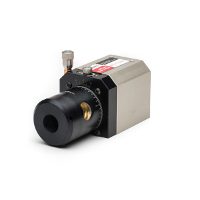
- Laser transmitter: Emits a laser bean as a reference line or plane for measurement.
- Laser receiver: Detects laser beam and measures deviations from the reference plane.
- Controller: Displays real-time data and measurements.
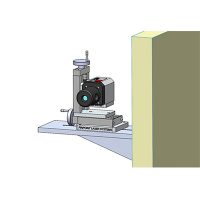
In operation, the laser is placed on a rotating mount that allows it to swing a full circle, defining a flat, precise plane of laser light. The laser is aimed at the receiver, which takes height or profile measurement at various points on the flange. For example, on a wind turbine, the laser system can check flatness of wing root, hug and tower flanges. These readings are used to assess flatness. Measurements can be recorded for reporting, creating surface maps and comparing tolerances with standards.
Laser alignment systems are a critical tool for flange inspection. By replacing manual methods, this high-precision technology ensures reliable joint performance, regulatory compliance, and long-term operational reliability in industries where flange integrity is vital to system performance and safety.